Disposable diapers are typically absorbent hygiene products and are mainly available as baby diapers and adult diapers. With changing family attitudes, the market penetration of baby diapers has reached 80-90% in developed countries, while adult incontinence products, which are mainly used to improve the quality of life of elderly and disabled people, have continued to see a rise in sales worldwide in recent years.
So what exactly is the structure and raw materials of nappies?
-
Top layer:The top layer is in direct contact with the baby’s delicate skin, so it needs to be soft and breathable, not absorbing water itself, but to keep the child’s bum dry, absorb urine quickly and prevent side leaks. The material used for the top layer is non-woven, of which the most commonly used are hot-air non-woven and spunbond non-woven fabrics. The hot-air non-woven fabric offers better performance and a softer surface.

![]()
-
Deflectorlayer:The deflector layer is located between the top layer and the absorbent core and serves to enable the diaper to absorb liquid quickly, efficiently and evenly. Since baby’s urine is drained locally in the diaper, if it is not evacuated to other locations in a timely and rapid manner, it can lead to a blockage in the local core of the diaper due to excessive absorption, which can lead to back seepage. Compared to the material of the top layer, the fibers of the deflector layer are arranged in a longitudinal direction. When urine reaches this layer, the fiber network of the layer will immediately absorb the liquid which, after temporary storage, will spread along the longitudinal fibers until it is absorbed by the core layer, to avoid local blockage of the core layer due to a large amount of absorbed liquid and back seepage.
-
Absorbent core:There are two core structures for diapers currently available on the market. One is the SAP paper core, which is an ultra-thin absorbent core made from a mixture of dust-free paper, Fluffy nonwoven and polymer in a certain ratio. This new type of core directs the urine to the polymer by guiding it through the dust-free paper, and the polymer is held in place by a layer of Fluffy nonwoven.
![]()
-
The other is the composite core, which is made up of fluff pulp and SAP. It works by guiding the urine into the absorbent core through the wood pulp fibers and then locking the urine via SAP in order to keep the surface of the diaper dry after absorbing a certain amount of urine. The presence of the wood pulp makes it impossible to solve some of the problems of puckering and breakage.
![]()
-
Hot melt glue:During the production of the diapers, the layers are laminated by using a certain amount of hot melt glue in a fully automated production line, combining a number of raw materials such as the top layer nonwoven, the leak-proof partition nonwoven, the core and the core-covered nonwoven.
![]()
-
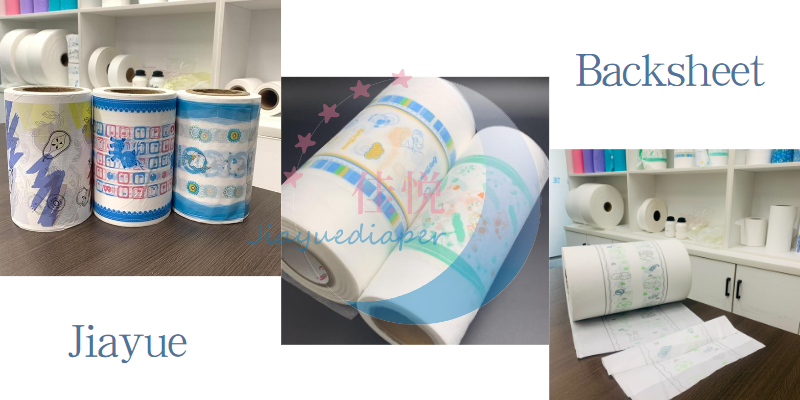
Backsheet:The backsheet is the water-resistant outer layer of the diaper and it prevents liquids from passing through the diaper and leaking onto the baby’s clothing or surrounding environment .In the backsheet film, it can be divided into PE film and breathable film.
![laminated film]()
There are still many raw materials used in diapers, but those that represent the highest proportion are the ones mentioned above.
Ang Jiayue ay isa sa mga propesyonal na supplier ng lampin sa Quanzhou, ang lampin produksyon base sa Tsina. We produce standard diaper raw materials, sanitary raw materyales, wet wipes raw materyales, isama ang hindi tela, spandex, SAP, PE film etc. Also standard and customized baby & matanda na & lampin ng alagang hayop, basa na & tuyo tuyo wipes, sa ilalim ng pad, feminine sanitary products and raw materials.
![feedback]()
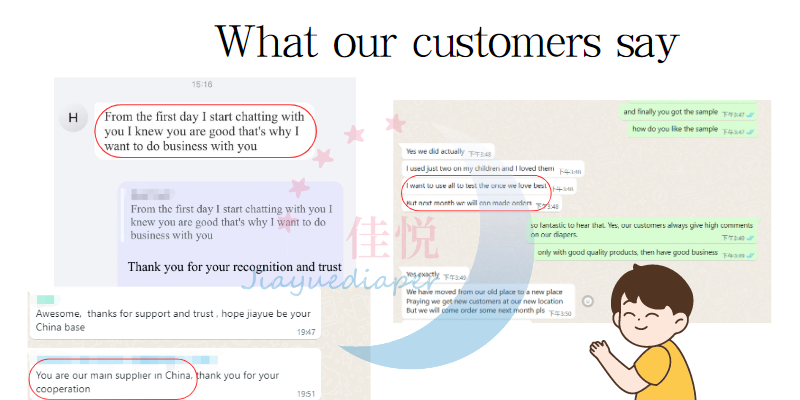
Jiayue support OEM/OBM/ODM and one-stop service solution, kami ay palaging itinuturing bilang isang pinagkakatiwalaang kaibigan ng aming mga regular na customer at maaari ring maging iyong mga mata sa China. Higit pang mga detalye maligayang pagdating sa makipag ugnay sa amin.