Abstract
The global market for adult incontinence products presents a complex sourcing dilemma for distributors, often centering on the comparative advantages of manufacturers in China and Japan. An inquiry into whether one should procure adult diapers from China or Japan reveals significant distinctions in manufacturing philosophy, technological application, and business models. This analysis examines the two markets through five critical lenses: manufacturing scale and cost-effectiveness; technological innovation and material science; quality control and regulatory adherence; OEM/ODM flexibility; and market-oriented product design. Japanese manufacturing is characterized by a focus on premium, technologically advanced products for a discerning domestic market, often resulting in higher costs and less flexible production arrangements. Conversely, Chinese manufacturing has evolved to leverage immense economies of scale, rapid technological adoption, and highly adaptable OEM/ODM services to cater to a diverse global clientele. This objective comparison provides a data-supported framework for international businesses to navigate the sourcing landscape, aligning their procurement strategies with specific market demands, quality requirements, and profitability goals for 2025.
Key Takeaways
- Chinese manufacturers offer superior cost-effectiveness due to massive economies of scale.
- Japanese innovation excels in premium materials, while China rapidly integrates new technologies.
- Reputable Chinese factories now hold key international certifications like CE, FDA, and ISO.
- China provides highly flexible OEM/ODM services with lower minimum order quantities.
- Consider if adult diapers from China or Japan better fit your target market's needs.
- Japanese products are often designed for domestic preferences, focusing on ultimate softness.
- Chinese suppliers offer a wider range of product tiers, from economy to premium.
Table of Contents
- A Foundational Question: Sourcing Adult Diapers from China or Japan
- Point 1: Manufacturing Scale and Cost-Effectiveness
- Point 2: Technological Innovation and Material Science
- Point 3: Quality Control and Regulatory Standards
- Point 4: OEM/ODM Flexibility and Customization
- Point 5: Market Focus and Product Design Philosophy
- Frequently Asked Questions (FAQ)
- A Concluding Perspective on Strategic Sourcing
- References
A Foundational Question: Sourcing Adult Diapers from China or Japan
For any business involved in the distribution of personal hygiene products, the question of origin is not merely a logistical detail; it is a strategic decision that reverberates through the entire value chain, from production costs to consumer satisfaction. When contemplating the landscape of incontinence care, the query "Has anybody tried adult diapers from China or Japan?" emerges as a central, recurring theme among importers and distributors worldwide. This is not a simple question of preference but a complex inquiry into the fundamental differences between two of the world's most formidable manufacturing powerhouses. The decision to source from one over the other carries profound implications for a brand's market positioning, profitability, and long-term growth.
To approach this question with the necessary rigor, one must move beyond anecdotal evidence and superficial comparisons. A deep, structured analysis is required, one that appreciates the distinct industrial trajectories, cultural values, and economic structures that shape the products each nation offers. Japan, long celebrated as a bastion of meticulous quality and pioneering innovation, has historically set the benchmark in the hygiene sector. Its products are often perceived as the gold standard, born from a culture that prizes perfection and a market of highly sophisticated consumers. On the other hand, China, the world's manufacturing engine, has undergone a dramatic transformation. Shedding an outdated reputation for low-cost, low-quality goods, its leading manufacturers have ascended to become global leaders in their own right, combining massive scale with advanced technology and a keen understanding of diverse international markets.
This exploration will therefore serve as a comprehensive guide, breaking down the comparison into five core pillars. We will examine the economic realities of manufacturing scale, delve into the nuances of material science and technological innovation, scrutinize the frameworks of quality control, assess the critical importance of customization capabilities, and finally, consider the design philosophies that cater to different global consumers. Through this methodical examination, a clear and actionable picture will emerge, empowering you, the distributor, to make an informed decision that aligns perfectly with your business's unique strategic objectives in the dynamic global market of 2025.
Point 1: Manufacturing Scale and Cost-Effectiveness
The economic logic of production is the bedrock upon which any successful distribution business is built. When evaluating adult diapers from China or Japan, the most immediate and impactful point of divergence lies in their manufacturing scale and the resulting cost structures. These differences are not incidental; they are the direct outcomes of distinct national industrial strategies and economic priorities. Understanding this financial landscape is the first step toward making a strategically sound sourcing decision. China's approach is defined by its unparalleled economies of scale, while Japan's is characterized by a more focused, premium-oriented production model.
The Unmatched Economies of Scale in Chinese Manufacturing
China's status as the "world's factory" is nowhere more evident than in the disposable hygiene products industry. The sheer volume of production is staggering. Factories like Foshan Huikang Paper Industry Co., Ltd. report an annual output of 3 billion pieces from over 30 production lines . Similarly, Zhejiang Uniquality Nursing Products Technology Co., Ltd. cites a capacity of 1 billion baby diapers annually alongside immense capabilities in wet and dry wipes . This massive scale creates a powerful virtuous cycle. High-volume production allows manufacturers to negotiate significantly lower prices for raw materials such as nonwoven fabrics, superabsorbent polymer (SAP), and fluff pulp.
This purchasing power is a structural advantage that is difficult for smaller-scale operations to overcome. Moreover, the immense output allows for the optimization of production lines, minimizing downtime and maximizing efficiency. Automated, high-speed machinery, as noted by Fujian Jiayue Sanitary Products Co., Ltd., which highlights production speeds of up to 630 pieces per minute, further drives down the cost per unit . The logistical infrastructure supporting these operations—from integrated supply chains to proximity to major shipping ports—compounds these efficiencies. For a global distributor, this translates directly into a lower ex-factory price, providing the necessary margin to compete effectively in price-sensitive markets across Southeast Asia, the Middle East, or even certain segments in Europe and the Americas.
Japan's Premium-Focused, High-Cost Production Environment
In contrast, Japan's manufacturing environment for adult diapers operates on a different set of principles. The focus is less on global volume and more on serving a highly demanding domestic market with premium, high-value products. Japanese labor costs are substantially higher than in China, which is a significant factor in the final product cost. Furthermore, Japanese manufacturers often prioritize sourcing the absolute highest grade of specialized materials, which may come at a premium price.
While this commitment to excellence results in products with exceptional qualities, such as remarkable softness and thinness, it also builds a higher cost base into each unit. Production runs are often smaller and may be less flexible compared to the vast operations in China. The industrial ecosystem is geared toward innovation and refinement for a domestic consumer who is willing to pay more for perceived incremental benefits. For an international distributor, sourcing from Japan typically means acquiring a premium product at a premium price. This can be a viable strategy for niche markets where consumers prioritize brand origin and are less price-sensitive, but it presents a significant challenge when trying to achieve broad market penetration or compete on price.
Comparative Cost Structure Analysis
| Feature | Chinese Adult Diaper Manufacturing | Japanese Adult Diaper Manufacturing |
|---|---|---|
| Production Scale | Massive (billions of units annually) | Moderate to Large |
| Raw Material Sourcing | Bulk purchasing power, lower cost | Sourcing of premium, often specialized materials at higher cost |
| Labor Costs | Relatively low and efficient | Significantly higher |
| Unit Cost | Highly competitive, lower ex-factory price | Higher, reflecting premium inputs and labor |
| Market Orientation | Global, with tiers from economy to premium | Primarily domestic, premium-focused |
| Supply Chain | Highly optimized for global export | Optimized for domestic distribution, can be less flexible for export |
The table above crystallizes the fundamental economic trade-off. Sourcing adult diapers from China provides a distinct advantage in cost-effectiveness, driven by a manufacturing ecosystem built for scale and efficiency. This allows for competitive pricing and the potential for higher margins. Sourcing from Japan, while offering a product with a strong reputation for quality, requires a business model that can absorb and justify a higher cost structure.
Point 2: Technological Innovation and Material Science
Beyond cost, the technological sophistication of a product is a primary determinant of its performance and market appeal. In the realm of incontinence care, this translates to absorbency, comfort, skin health, and discretion. Both China and Japan are formidable players in technological advancement, yet they channel their innovative energies in distinct ways. Japan has long been the pioneer, especially in material science, while China has become an expert at rapid technological adoption, integration, and large-scale implementation. A nuanced understanding of these innovative pathways is vital when deciding between adult diapers from China or Japan.
Japan's Pioneering Role in Advanced Materials
The Japanese hygiene industry's reputation is built on a foundation of groundbreaking innovation in materials. Japanese companies were among the first to perfect the use of superabsorbent polymer (SAP), the core material responsible for locking away liquid and keeping the skin dry. Their research and development efforts have consistently pushed the boundaries of what is possible, leading to the creation of incredibly thin yet highly absorbent cores. This focus on "less is more" caters to a key consumer demand: discretion. A thinner diaper is less noticeable under clothing, which is a matter of dignity and confidence for the user.
Japanese manufacturers are also renowned for their mastery of nonwoven fabrics. They have developed proprietary techniques to produce materials that are exceptionally soft to the touch, reducing the risk of skin irritation and enhancing user comfort. This relentless pursuit of incremental improvements in texture, breathability, and fluid management has solidified Japan's image as the source of the most technologically refined and comfortable products on the market. For a distributor targeting the high-end medical or premium consumer sector, the "innovated in Japan" story can be a powerful marketing tool.
China's Ascendancy Through Rapid Adoption and Integration
While Japan has been the traditional innovator, China's technological story is one of breathtaking speed and scale. Chinese manufacturers may not have invented many of the core technologies, but they have become masters of adopting, refining, and mass-producing them. Leading Chinese companies have invested heavily in state-of-the-art production lines imported from Germany, France, and Italy, as noted by Zhejiang Kingsafe Hygiene Materials Technology Co., Ltd., a major supplier of the raw nonwoven materials themselves . This allows them to replicate and often enhance the technologies pioneered elsewhere.
Furthermore, the Chinese manufacturing ecosystem fosters intense competition, which drives rapid innovation cycles. Companies like actively promote their use of high-quality SAP and breathable backsheets, demonstrating that features once exclusive to premium Japanese products are now standard in high-tier Chinese offerings. The focus in China is often on practical innovation that solves problems for a global audience. This might include developing dual-core absorbent systems for enhanced capacity, creating more secure anti-leak guards for active users, or formulating products specifically for sensitive skin without the premium price tag. The advantage for a distributor is clear: access to products with modern, high-performance features without the high cost associated with Japanese-origin goods. This allows a brand to offer a technologically advanced product to a much broader consumer base.
The Divergence in R&D Philosophy
The difference in innovation can be traced back to a fundamental divergence in research and development (R&D) philosophy. Japanese R&D is often deep and narrow, focusing on perfecting a single material or achieving a specific sensory attribute. It is a patient, long-term process aimed at achieving ultimate perfection.
Chinese R&D, in contrast, is often broad and market-driven. It is about speed and application. Chinese manufacturers excel at reverse-engineering and improving existing technologies, quickly integrating them into new product lines. They are highly responsive to feedback from international partners, readily developing new features or product variants to meet specific market needs. A distributor might find it easier to collaborate with a Chinese manufacturer on developing a custom product, as the R&D process is geared toward flexibility and rapid commercialization. This agility is a significant asset in a fast-moving consumer goods market. The choice between adult diapers from China or Japan, therefore, also becomes a choice between a perfected, but perhaps more rigid, product and a highly adaptable, rapidly evolving one.
Point 3: Quality Control and Regulatory Standards
The conversation around product quality is perhaps the most fraught with historical bias and outdated perceptions. For decades, the "Made in Japan" label has been synonymous with impeccable quality and zero defects, while the "Made in China" label carried connotations of inconsistency. However, in 2025, this black-and-white view is no longer accurate. While Japan's reputation for quality remains well-deserved, leading Chinese manufacturers have made monumental strides in quality control, now operating under the same international standards as their global competitors. For a distributor, understanding the modern reality of quality assurance is paramount to mitigating risk and building a reputable brand.
Japan's Enduring Culture of Quality
Quality in Japan is not just a process; it is a cultural imperative. The concept of kaizen, or continuous improvement, is deeply embedded in the manufacturing psyche. This philosophy drives an obsession with detail, process control, and the elimination of defects. Japanese factories are known for their incredibly stringent internal quality checks, which often exceed the requirements of international standards. Every component, from the SAP to the adhesive tapes, is rigorously tested. The final product is expected to be flawless.
This commitment is reflected in their adherence to the Japanese Industrial Standards (JIS), a set of demanding benchmarks for product performance. Sourcing from Japan provides a high degree of confidence in the consistency and reliability of the product. The risk of receiving a substandard batch is exceptionally low. This assurance is a significant value proposition, especially for distributors in the medical and institutional channels, where product failure can have serious consequences. The trade-off, as always, is that this level of quality assurance is factored into the higher unit cost.
The Transformation of Quality Assurance in China
The most significant development in the global hygiene market over the past decade has been the quality revolution in China. Recognizing that quality is the key to unlocking global markets, top-tier Chinese manufacturers have invested massively in both technology and management systems to elevate their standards. It is no longer a choice between low price and high quality; leading Chinese suppliers now offer both.
A clear indicator of this transformation is the widespread adoption of international quality management and product safety certifications. Reputable manufacturers like and JIAYUE prominently display their compliance with a host of global standards. These are not mere formalities; they represent a fundamental commitment to systematic quality control.
Key International Certifications Held by Leading Chinese Manufacturers
| Certification | Purpose | Relevance for Distributors |
|---|---|---|
| ISO 9001 | Quality Management Systems | Ensures the factory has a systematic, process-driven approach to quality control and consistency. |
| CE Mark | Conformity for European Economic Area | A mandatory requirement for selling medical devices, including many adult diapers, in the EU. |
| FDA Registration | U.S. Food & Drug Administration | Necessary for marketing medical-grade incontinence products in the United States. |
| BSCI | Business Social Compliance Initiative | Verifies ethical working conditions, crucial for corporate social responsibility (CSR) compliance. |
| Dermatest | Dermatological Testing | Provides independent verification that the product is skin-safe and non-irritating, a powerful marketing claim. |
The presence of these certifications from a potential Chinese partner is a non-negotiable proof point. It demonstrates that the factory has been audited by independent third parties and meets the same fundamental quality and safety benchmarks required of manufacturers in Europe or North America. Many top factories operate "dust-free" or "cleanroom" workshops, as mentioned by HuiKang, to prevent contamination during production, a practice once associated primarily with high-tech electronics or pharmaceuticals. This modern reality means that when evaluating adult diapers from China or Japan, the quality discussion should not be about if a Chinese factory can meet high standards, but which Chinese factory has the proven systems to do so. A thorough due diligence process, including factory audits and reviewing certification documents, allows a distributor to secure a high-quality product at a Chinese price point.
Point 4: OEM/ODM Flexibility and Customization
For many distributors, the goal is not simply to resell an existing product but to build their own brand. This is where the concepts of Original Equipment Manufacturer (OEM) and Original Design Manufacturer (ODM) services become critically important. The ability to customize a product—from its absorbent core and materials to its packaging and branding—is what allows a distributor to differentiate itself in a crowded market. In this domain, the contrast between the typical business models of Chinese and Japanese manufacturers is particularly stark.
China's Dominance as an OEM/ODM Powerhouse
The modern Chinese manufacturing sector is built on a foundation of providing flexible, customized production for global brands. This is their core competency. Chinese hygiene product manufacturers are not just producers; they are partners in product development. As highlighted by virtually every major supplier, including JIAYUE and ZHEJIANG B.I. Industrial, the OEM/ODM service is a central part of their offering (, ).
This flexibility manifests in several key ways:
- Low Minimum Order Quantities (MOQ): Compared to manufacturers in many other regions, Chinese factories are often willing to work with lower MOQs. For example, HuiKang specifies MOQs in terms of container loads (e.g., 1-2 sizes in a 20ft container), which is a manageable scale for small to medium-sized distributors or for launching a new product without massive upfront investment. This lowers the barrier to entry for creating a private label brand.
- Extensive Customization Options: Chinese suppliers typically offer a menu of customizable options. A distributor can often specify the grade of SAP, the weight of the absorbent core, the type of topsheet (e.g., perforated, embossed), the style of the leg cuffs, the type of fastening tapes (e.g., PP tape, magic tape), and the design of the breathable backsheet. This allows for the creation of a product precisely tailored to a target price point and performance level.
- Packaging and Brand Design Support: Many Chinese manufacturers have in-house design teams or work with partners to help distributors develop their packaging. They understand the importance of shelf appeal and can provide guidance on creating a brand identity that will resonate in the target market.
- Collaborative Product Development: The relationship is often a partnership. A distributor can come to a Chinese ODM partner with a concept, and the manufacturer's R&D team will work with them to turn it into a viable, mass-producible product. This agility is invaluable for responding to changing market trends.
The More Rigid Structure of Japanese Manufacturing
Japanese manufacturers, with their focus on their own highly successful domestic brands (like Attento, Lifree, or Relief), are generally less oriented toward private label production for export. While some do offer OEM services, the terms are often more restrictive. MOQs are typically much higher, making it a viable option only for the largest multinational retailers or distributors.
The scope for customization may also be more limited. A Japanese manufacturer might offer a version of their existing product platform for private labeling, but they may be less willing to engage in ground-up development of a new product for a foreign partner. Their production lines are highly optimized for their own products, and retooling for a custom design can be seen as inefficient. The negotiation process can be more formal and lengthy. For a distributor looking for speed, flexibility, and a high degree of control over product specifications, navigating the Japanese OEM landscape can be challenging. This makes China the default choice for the vast majority of businesses looking to launch their own brand of premium adult nappies.
In essence, the choice in this domain is between a supplier who sees you as a client for their existing product, and a supplier who sees you as a partner in building your brand. The Chinese model is explicitly designed around the latter, offering a level of service and flexibility that empowers distributors to create unique products and compete effectively on a global scale.
Point 5: Market Focus and Product Design Philosophy
The final, and perhaps most subtle, point of comparison lies in the design philosophy behind the products. A diaper is not just a technical object; it is a product designed for a human being, shaped by cultural norms, body types, and lifestyle considerations. The divergent market focuses of Japanese and Chinese manufacturers lead to products with distinct characteristics. Choosing the right one depends on a deep understanding of your own target consumer. Answering the question "Has anybody tried adult diapers from China or Japan?" requires one to consider who is doing the trying and what their expectations are.
The Japanese Design: Optimized for the Domestic Consumer
Japanese adult diapers are masterfully engineered for the preferences of the Japanese consumer. Decades of market research in their home country have led to a specific set of design priorities:
- Extreme Softness: There is a cultural premium on softness and gentle touch. Japanese diapers often use the most delicate, cloth-like nonwovens available to ensure maximum comfort against the skin.
- Ultimate Discretion: As previously mentioned, thinness is paramount. Products are designed to be almost invisible under clothing, reflecting a societal value on modesty and not drawing attention to the condition of incontinence.
- Anatomical Fit for East Asian Body Types: The cut and sizing of Japanese diapers are optimized for the generally slimmer and smaller frames prevalent in East Asia.
- Moderate Absorbency for Frequent Changes: The healthcare philosophy in Japan often encourages more frequent changing of incontinence products to maintain skin hygiene. As a result, many standard Japanese products are designed for moderate absorbency rather than maximum capacity for extended wear.
While these characteristics create a superb product for their intended user, they may not be ideal for all global markets. In many Western or Middle Eastern markets, consumers may have larger body types, requiring a different size and cut. The emphasis on moderate absorbency might not meet the needs of users or caregivers who rely on a product for overnight protection or extended wear. The very high cost may also place it out of reach for the average consumer in many developing economies.
The Chinese Design: A Global and Adaptable Approach
Chinese manufacturers, by necessity and by design, have adopted a more global perspective. Their business model is predicated on exporting to dozens of countries across every continent. This has forced them to become experts in adaptability. A leading Chinese supplier like Yibero Diaper acts as a comprehensive cross-border enterprise, understanding that a product that sells well in Russia may need different features from one that succeeds in the Philippines or Saudi Arabia.
This global focus leads to a different design philosophy:
- Tiered Product Offerings: Chinese factories typically offer a wide range of products, from basic, economy-level diapers for institutional use or highly price-sensitive markets, to mid-tier products that balance cost and performance, to premium lines that compete directly with the best from Japan or Europe on features. This allows a distributor to select a product portfolio that matches the specific economic profile of their market.
- Customizable Absorbency Levels: Recognizing the varied needs of global consumers, Chinese OEM services allow for the precise specification of absorbency levels. A distributor can order a product with a very high SAP content for an overnight or maximum-security product, or a lighter version for a daytime "light incontinence" pad.
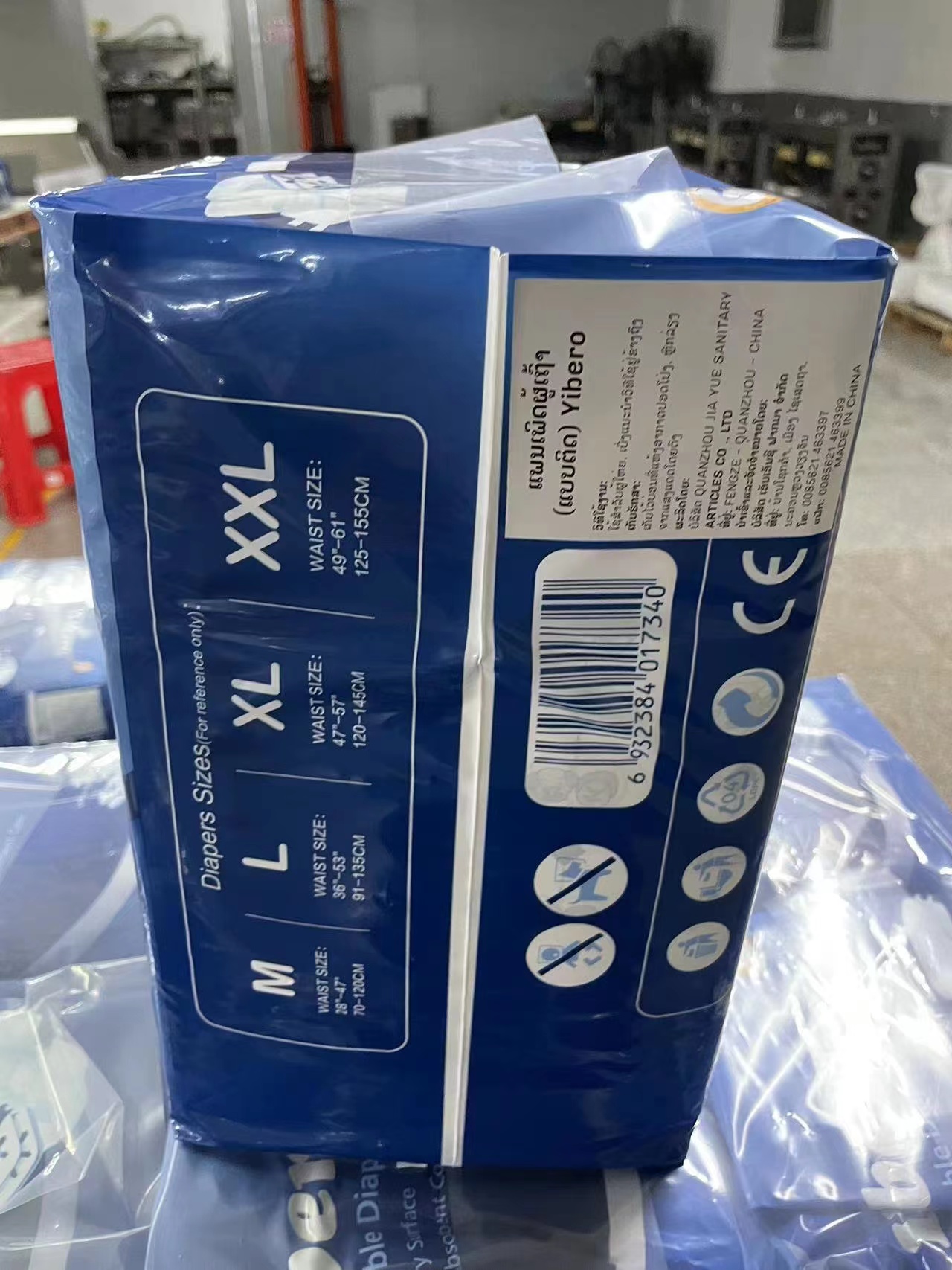
- Versatile Sizing and Fit: Chinese manufacturers are accustomed to producing for diverse body types and offer a wider range of sizes (e.g., M, L, XL, XXL) with designs that accommodate different builds.
- Market-Specific Feature Development: They are responsive to developing features for specific markets, such as adding wetness indicators with custom graphics, using stronger adhesive tapes for hot and humid climates, or incorporating odor-control technologies like charcoal or green tea extracts that are popular in certain regions.
Ultimately, sourcing from China offers a distributor a toolkit rather than a single fixed product. It provides the flexibility to build a product that is not just "good," but is specifically "right" for the intended customer. When considering adult diapers from China or Japan, the question evolves from "Which is better?" to "Which is better for my customers?" For most international distributors aiming for broad market appeal and customized solutions, the adaptable, global-first design philosophy of Chinese manufacturers presents a more versatile and strategic path to success.
Frequently Asked Questions (FAQ)
1. Is the quality of SAP (Superabsorbent Polymer) from China comparable to that from Japan? Yes, the quality of SAP from top-tier Chinese suppliers is now highly comparable. While Japan was a pioneer in SAP technology, the market has globalized. Major global SAP manufacturers (from Germany, Japan, and the USA) have plants in China or supply directly to large Chinese diaper manufacturers. Furthermore, Chinese chemical companies have developed their own high-performance SAP that meets international standards for absorbency, retention, and safety. A reputable diaper manufacturer will provide specification sheets detailing the SAP's performance metrics, allowing you to verify the quality.
2. I've heard about issues with inconsistent quality in Chinese products. Is that still a risk? While this was a valid concern in the past, the industry has matured significantly. The risk today is not with "Chinese products" as a monolith, but with inexperienced or uncertified factories. By partnering with established manufacturers who hold international certifications like ISO 9001, CE, and FDA, you are working with a company that has proven, auditable quality management systems. The key is thorough due diligence: request certifications, ask for third-party test reports (like Dermatest), and if possible, conduct a factory audit. This mitigates the risk of inconsistency.
3. What is a realistic lead time for a first OEM order from a Chinese diaper manufacturer? For a first OEM order, a realistic lead time is typically 30-45 days after the deposit is paid and the packaging design is finalized. As noted by manufacturers like HuiKang, subsequent orders are often faster, around 15-30 days. The initial order takes longer because it includes the time needed for creating and printing the new packaging materials (bags, cartons), which is a one-time setup process. It is wise to factor this initial timeframe into your business plan.
4. Can I get a product that is both eco-friendly and affordable from a Chinese manufacturer? Absolutely. This is a growing area of innovation in China. Many manufacturers now offer eco-friendlier options as part of their OEM services. This can include using fluff pulp from sustainably managed forests (with FSC certification), offering biodegradable polybags for packaging, or developing diapers with a higher percentage of plant-based materials. Because they operate at scale, they can often provide these greener options at a more accessible price point than smaller, boutique eco-brands from other regions.
5. How do I handle logistics and importation when sourcing from China? Experienced Chinese manufacturers are well-versed in global logistics and can provide comprehensive support. They typically offer FOB (Free On Board) pricing, meaning they are responsible for getting the goods to the designated port in China. They will assist with all necessary export documentation. You will need to partner with a freight forwarder and a customs broker in your own country to manage the ocean shipping, customs clearance, duties/taxes, and final delivery. Many manufacturers can recommend reliable logistics partners they have worked with for your specific region.
A Concluding Perspective on Strategic Sourcing
The deliberation over sourcing adult diapers from China or Japan is not a simple choice between good and bad, or cheap and expensive. It is a sophisticated strategic exercise in aligning a product's attributes with a specific market's needs and a business's financial structure. The evidence from 2025 indicates that while Japan continues to produce exceptionally high-quality, premium products born from a culture of meticulous refinement, its model is often best suited for niche applications or markets where price is a secondary consideration.
The narrative of Chinese manufacturing has profoundly changed. The leading edge of the industry now represents a powerful synthesis of scale, speed, quality, and adaptability. Through massive investment in technology and adherence to global quality standards, reputable Chinese manufacturers have closed the quality gap. They offer products featuring advanced materials and performance characteristics that are competitive with the best in the world. Their true differentiating strength, however, lies in their business model. The unparalleled flexibility of their OEM/ODM services empowers distributors to become true brand builders, to craft products with precision for their target demographics, and to do so with a cost structure that allows for both competitive pricing and healthy profitability. For the modern global distributor, the Chinese hygiene products industry offers not just a product, but a partnership and a platform for growth. The most successful sourcing strategy will therefore be one rooted in rigorous due-diligence to identify these top-tier partners, leveraging their immense capabilities to deliver the right product, at the right price, for any market in the world.
References
Associated Hygienic Products LLC. (2025). Company overview. UNIS. Retrieved from
Foshan Huikang Paper Industry Co., Ltd. (2025). Diaper manufacturer. HuiKang Diaper. Retrieved from
Fujian Jiayue Sanitary Products Co., Ltd. (2024). Diaper wholesale supplier & wet wipes manufacturer. JIAYUE. Retrieved from
Kilic, M., & Dincer, H. (2021). Analyzing the innovation strategies for the white goods industry. In Contributions to management science (pp. 57–74). Springer International Publishing.
Li, Y., & Li, X. (2020). The impact of quality certification on the export performance of enterprises: Evidence from China. The World Economy, 44(3), 824–849. https://doi.org/10.1111/twec.13022
O’Connor, T. (2023). Global adult incontinence market size, share, & trends analysis report. Grand View Research. Retrieved from https://www.grandviewresearch.com/industry-analysis/adult-incontinence-market
Xing, Y. (2019). How the U.S.-China trade war is changing global supply chains. In Trade war: The clash of economic systems (pp. 119-141). Palgrave Macmillan, Cham.
Zhejiang B.I. Industrial Co., Ltd. (2025). Adult care. BI-Ehealthcare. Retrieved from
Zhejiang Uniquality Nursing Products Technology Co., Ltd. (2023). OEM private label wipes, diapers manufacturers, suppliers, factory. UQCARE. Retrieved from
Zhu, Q., & Sarkis, J. (2016). Green supply chain management: Pressures, practices and performance within the Chinese automobile industry. Journal of Cleaner Production, 14(1-2), 48-61.


